
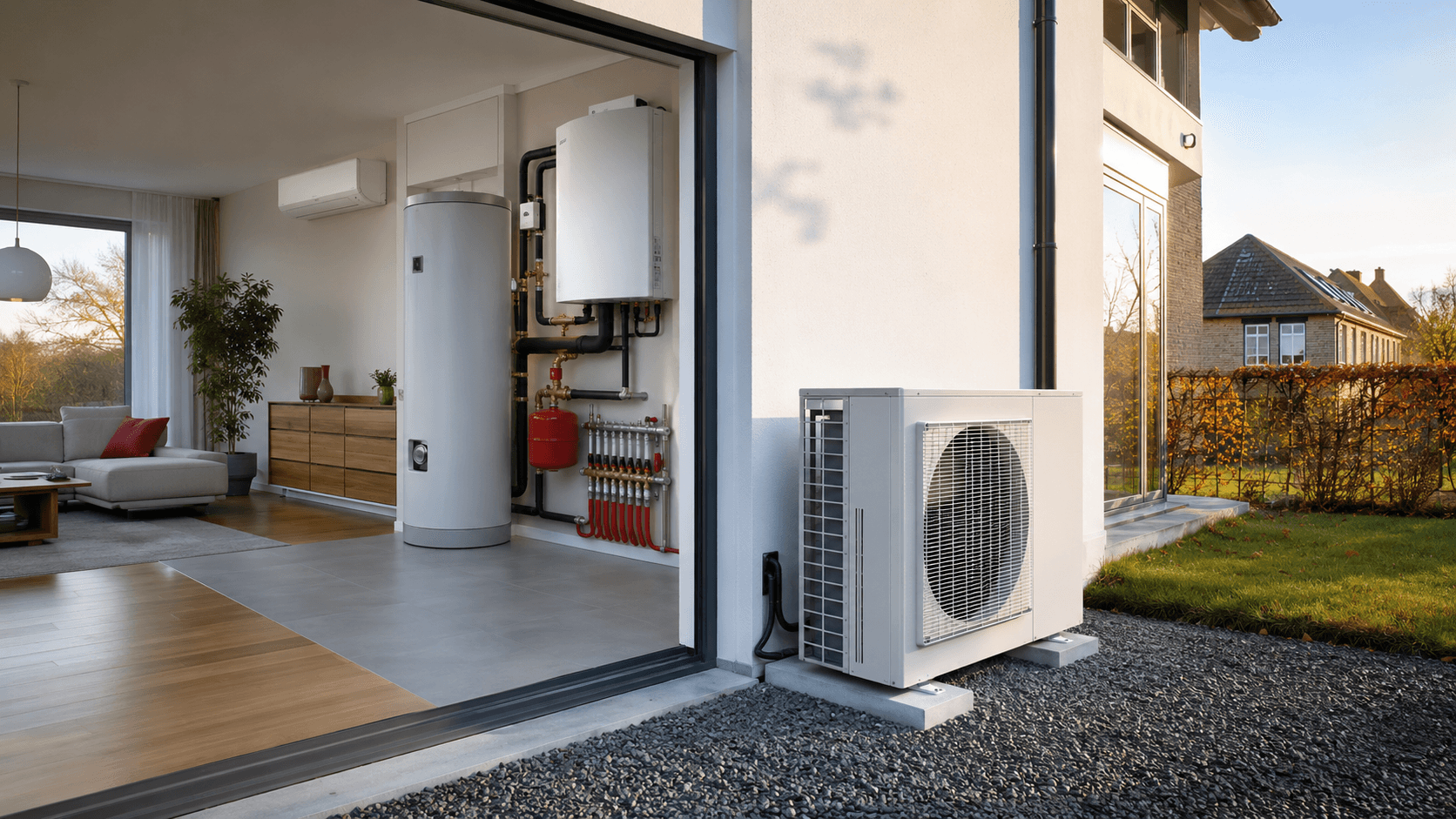
Daikin has unveiled the X Series, a residential heat-pump platform that combines two technologies normally installed as separate systems. One outdoor unit can provide air-to-air heating and cooling through indoor air conditioners while also supplying an Altherma air-to-water module for underfloor heating, radiators and domestic hot water.
Announced in Brussels on 10 July 2026, the system is intended for new homes and extensively renovated properties of up to 150 m², particularly where outdoor space is limited. The European rollout is scheduled to begin in phases from September 2026, with availability varying by country.
Five connections on a single outdoor unit
The outdoor unit provides five connections: up to four can serve air-to-air indoor units, while the fifth is dedicated to the hydronic module. Daikin says wall-mounted, floor-standing, ducted and cassette indoor units can be selected according to the rooms and layout.
On the water side, the Altherma indoor unit can feed low-temperature radiators or underfloor heating and prepare domestic hot water. Integrated cylinder options of 180 and 230 litres are planned. Importantly, Daikin says the air-to-air and air-to-water sections can operate simultaneously in the same mode.
Why this mixed architecture is interesting
A conventional all-in-one air-to-water heat pump can heat a home and produce hot water, but active summer cooling requires suitable fan coils or a carefully designed floor-cooling installation. Split air conditioners provide responsive heating and cooling, yet do not normally produce domestic hot water. X Series brings both approaches together.
The main practical gain is the single outdoor unit. That can simplify a façade, reduce the number of outdoor locations required and make a mixed installation possible where planning or space constraints would rule out two separate machines. It may also allow rooms to be equipped progressively, although the refrigerant and hydraulic design still needs to be planned as one coherent system.
Onecta monitoring and voice control
The system connects to Daikin’s Onecta application for temperature control, schedules, domestic-hot-water settings and monitoring of the connected air-to-air units’ energy consumption. Alexa and Google Assistant voice control are also announced.
App integration is useful, but buyers should still ask what energy data is measured directly, what depends on estimates and which functions remain available locally if the internet connection is interrupted.
R-32 rather than the newest low-GWP refrigerants
Daikin has selected R-32 refrigerant. It is familiar to installers and remains widely used in residential air conditioning, but its global-warming potential is higher than that of propane-based R-290 systems now appearing in the air-to-water market.
This does not make X Series obsolete, but it is a relevant long-term comparison point. The quantity of refrigerant, pipe lengths, leak-check obligations and future servicing costs should be discussed in the quotation, especially for a multi-room installation.
The questions to ask before ordering
Daikin has not yet published every market-specific price, capacity combination or seasonal-efficiency figure. A serious proposal will need a room-by-room heat-loss and cooling-load calculation, an assessment of the existing emitters, the required hot-water volume and a check of the electrical supply.
Also compare the complete installed price with two independent systems. A single outdoor unit saves space, but it also concentrates several household functions in one machine: backup heating, hot-water continuity and service response become more important if a fault occurs.
HomeSpecLab’s view
X Series is a technically coherent response to a real renovation problem: households increasingly want efficient hot water and heating without giving up proper summer air conditioning. Combining the two circuits behind one outdoor unit is more elegant than multiplying equipment on the façade.
The concept deserves attention, but the buying decision should wait for local pricing, certified performance data and installer proposals. Its strongest use case is likely a well-insulated home that needs several air-conditioned rooms, low-temperature hydronic heating and domestic hot water, while having room for only one outdoor unit.
Sources
Official Daikin X Series announcement, 10 July 2026.
Related buying tools
Continue with the most relevant calculator or guide.
HomeSpecLab works best when calculators, buying guides and product picks reinforce each other. Use these links to move from sizing to shopping criteria.